



July 14, 2026
Why You Shouldn’t Try to Outguess the Market

By Chris Palabe, CFS, AIF®
Introduction
One of the biggest investing mistakes isn’t choosing the wrong investment—it’s trying to predict when to get in and out of the market.
It sounds simple enough:
“I’ll get out before the market drops and buy back in when things look better.”
The challenge is that this strategy requires getting two decisions exactly right: knowing when to sell and knowing when to reinvest.
While this may seem achievable in theory, history has shown that consistently timing the market is extraordinarily difficult—even for professional investors.¹
1. Timing the Market Requires Two Perfect Decisions
Successfully timing the market means more than simply avoiding a downturn.
You must first decide when to sell and then determine the right time to reinvest. Missing either decision can have a meaningful impact on long-term returns.
Unfortunately, the market doesn’t announce when it’s about to recover. In fact, many of the market’s strongest days have historically occurred shortly after some of its weakest days—when uncertainty and fear are often at their highest.¹
Planning note:
Trying to avoid short-term volatility can increase the risk of missing long-term growth opportunities.
2. Missing the Best Days Can Be Costly
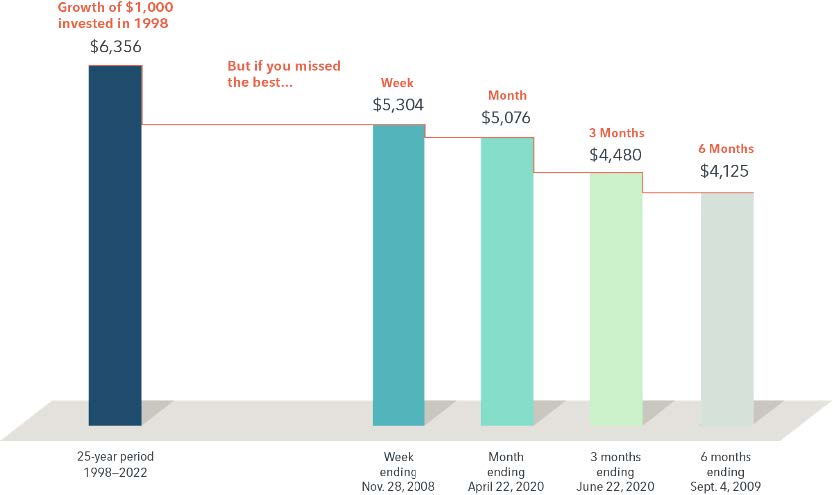
The accompanying chart illustrates how remaining invested has historically compared with missing just a handful of the market’s strongest periods. Over the 25-year period from 1998 through 2022, a hypothetical $1,000 investment grew to approximately $6,356 when it remained fully invested. Missing only the best week reduced the ending value to about $5,304, while missing the best six months reduced it to approximately $4,125.
The difference is significant.
The challenge is that no one knows in advance when those strongest periods will occur. They often happen during times when investors are feeling the least confident about the market.
Planning note:
Some of the market’s strongest recoveries have historically occurred during periods of heightened uncertainty.¹
3. Staying on the Sidelines Is Still a Decision
When markets become volatile, many investors decide to wait until conditions feel more certain before investing.
While this may feel like avoiding risk, it is actually an investment decision in itself.
Remaining in cash means accepting the possibility that markets recover while your money remains on the sidelines. Likewise, remaining invested means accepting the normal ups and downs that have historically accompanied long-term market growth.
The key is to make intentional decisions based on your financial goals—not emotions or short-term headlines.
Planning note:
Inaction is an action and can be the right decision when it is part of a thoughtful financial plan. The important thing is that your decision is intentional rather than emotional.
4. Focus on What You Can Control
Rather than trying to predict the market’s next move, successful investors often focus on the factors they can control.
These may include:
- Maintaining a diversified portfolio.
- Investing according to long-term goals.
- Rebalancing periodically.
- Remaining disciplined during periods of market volatility.
While no one can control short-term market performance, investors can control how they respond to changing market conditions.
Planning note:
Long-term investment success is often built on discipline and consistency rather than short-term predictions.
Strategic Considerations
Markets will inevitably experience periods of uncertainty, corrections, and volatility. Those periods can be uncomfortable, but they have also been a normal part of long-term investing.
Rather than attempting to predict every market movement, investors may benefit from following a disciplined investment strategy designed around their individual goals, risk tolerance, and time horizon.
Key Takeaways
Trying to outguess the market may feel productive, but history suggests it can be one of the costliest investing mistakes. Missing even a relatively small number of the market’s strongest days can significantly affect long-term results.¹
While no investment strategy eliminates risk, maintaining a disciplined, diversified approach and focusing on long-term objectives has historically helped investors navigate changing market environments more effectively.
At Palabe Wealth, we help clients build investment strategies designed to support their long-term financial goals through all stages of the market cycle.
As always, Palabe Wealth is here to help. If you have any questions regarding your financial plan, please feel free to reach out at chris.palabe@lpl.com.
References
- J.P. Morgan Asset Management, Guide to the Markets, “The Cost of Timing the Market” and long-term market history, 2025.
- DALBAR, Quantitative Analysis of Investor Behavior (QAIB), latest edition.
- Vanguard Research, Principles for Investing Success.
Disclosures
This material is for general informational purposes only and is not intended to provide specific tax, legal, or investment advice. Individuals should consult with their tax advisor, financial professional, or attorney regarding their unique circumstances. Past performance, including hypothetical performance, is no guarantee of future results. Investing involves risk, including the possible loss of principal. Securities and advisory services offered through LPL Financial, a registered investment advisor and member FINRA/SIPC. Palabe Wealth and LPL Financial are separate entities.

Chris Palabe, CFS, AIF®
Chris Palabe is the CEO and a Financial Advisor at Palabe Wealth, a firm that provides exceptional expertise in the Financial Planning space. For over 25 years, he has cultivated a deep understanding of the complexities of wealth management and retirement planning, making him a valued advisor to both Plan Sponsors of 401(k) plans and Individual Investors.
Holding esteemed designations such as Certified Fund Specialist (CFS) and Accredited Investment Fiduciary (AIF), Chris showcases his commitment to upholding the highest standards of investment advice and fiduciary responsibility in his advisory relationships. These designations are a testament to his knowledge and dedication to providing clients with sophisticated and ethical financial guidance.
He holds his Series 6, 7, 63, and 65 licenses through LPL Financial, which qualify him to offer a broad range of financial products and services.
Chris’s distinguished career is characterized by his unwavering commitment to his clients' financial well-being. He focuses on crafting tailored strategies that aim to optimize retirement outcomes and financial independence. He continually strives to help the individuals he works with on their path towards financial success.
Over the years Chris has refined a consistent, strategic investment philosophy supported by a significant body of academic research. He believes that a widely diversified portfolio of investments tailored to each client’s unique risk tolerance and financial goals is the key to their financial success.
Beyond his professional achievements, Chris has a profound passion for dressage, a highly skilled form of horse riding performed in exhibition and competition. This discipline requires a remarkable level of dedication, precision, and harmony between rider and horse, qualities that mirror his approach to financial planning.